Articles | Volume 14, issue 1
https://doi.org/10.5194/jsss-14-75-2025
© Author(s) 2025. This work is distributed under
the Creative Commons Attribution 4.0 License.
Special issue:
https://doi.org/10.5194/jsss-14-75-2025
© Author(s) 2025. This work is distributed under
the Creative Commons Attribution 4.0 License.
A versatile development platform for odor monitoring systems
Maximilian Koehne
CORRESPONDING AUTHOR
Fraunhofer Institute for Process Engineering and Packaging IVV, 85354 Freising, Germany
Department of Systems Engineering, Saarland University, 66123 Saarbrücken, Germany
Omar Tarek Penagos Carrascal
Fraunhofer Institute for Process Engineering and Packaging IVV, 85354 Freising, Germany
Department of Systems Engineering, Saarland University, 66123 Saarbrücken, Germany
Michael Czerny
Fraunhofer Institute for Process Engineering and Packaging IVV, 85354 Freising, Germany
Tilman Sauerwald
CORRESPONDING AUTHOR
Fraunhofer Institute for Process Engineering and Packaging IVV, 85354 Freising, Germany
Department of Systems Engineering, Saarland University, 66123 Saarbrücken, Germany
Related authors
Maximilian Koehne, Michael Henfling, Kristina Amtmann, Andreas Stenzel, Andrea Buettner, Sabine Trupp, Gina Zeh, and Tilman Sauerwald
J. Sens. Sens. Syst., 13, 263–275, https://doi.org/10.5194/jsss-13-263-2024, https://doi.org/10.5194/jsss-13-263-2024, 2024
Short summary
Short summary
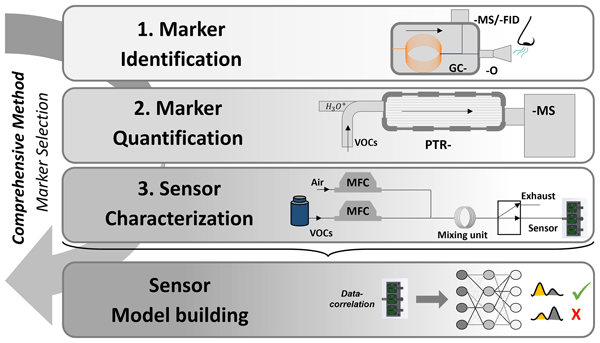
Continuous quality monitoring has become increasingly important in industrial processes, such as raw-milk monitoring. This can often be achieved by detecting individual process markers in the gas phase, which requires inexpensive analytical systems. Therefore, an easy-to-implement three-step concept has been developed that aims to bring together the chemical–analytical and sensor–technical sides. This concept is designed to be applicable in a wide variety of cases and to a range of sensors.
Maximilian Koehne, Christopher Schmidt, Satnam Singh, Andreas Grasskamp, Tilman Sauerwald, and Gina Zeh
J. Sens. Sens. Syst., 12, 215–223, https://doi.org/10.5194/jsss-12-215-2023, https://doi.org/10.5194/jsss-12-215-2023, 2023
Short summary
Short summary
Continuous inspection of gases is increasingly important for process monitoring, like fruit ripening. This involves the detection of individual markers in complex gas mixtures, e.g., to indicate spoilage. Unfortunately, classical techniques are lab-bound and resource-intensive. Hence, small, low-cost systems are being developed. Thereto, we propose a sensor system, containing a non-heated gas separation unit and gas sensors combined with a compensation of surrounding temperature effects.
Wolfhard Reimringer, Helen Haug, and Tilman Sauerwald
J. Sens. Sens. Syst., 15, 35–46, https://doi.org/10.5194/jsss-15-35-2026, https://doi.org/10.5194/jsss-15-35-2026, 2026
Short summary
Short summary
This article presents first results from our research on the improvement of post-consumer recycled plastics in a suitable measurement situation on the compounding extruder, where the material is molten and by-products are removed by a vacuum. An extraction system was implemented, and samples were analyzed with laboratory methods. The results give insight into occurring substances and show the feasibility of the technique. Guidelines for an online sampling and monitoring system are derived.
Maximilian Koehne, Michael Henfling, Kristina Amtmann, Andreas Stenzel, Andrea Buettner, Sabine Trupp, Gina Zeh, and Tilman Sauerwald
J. Sens. Sens. Syst., 13, 263–275, https://doi.org/10.5194/jsss-13-263-2024, https://doi.org/10.5194/jsss-13-263-2024, 2024
Short summary
Short summary
Continuous quality monitoring has become increasingly important in industrial processes, such as raw-milk monitoring. This can often be achieved by detecting individual process markers in the gas phase, which requires inexpensive analytical systems. Therefore, an easy-to-implement three-step concept has been developed that aims to bring together the chemical–analytical and sensor–technical sides. This concept is designed to be applicable in a wide variety of cases and to a range of sensors.
Maximilian Koehne, Christopher Schmidt, Satnam Singh, Andreas Grasskamp, Tilman Sauerwald, and Gina Zeh
J. Sens. Sens. Syst., 12, 215–223, https://doi.org/10.5194/jsss-12-215-2023, https://doi.org/10.5194/jsss-12-215-2023, 2023
Short summary
Short summary
Continuous inspection of gases is increasingly important for process monitoring, like fruit ripening. This involves the detection of individual markers in complex gas mixtures, e.g., to indicate spoilage. Unfortunately, classical techniques are lab-bound and resource-intensive. Hence, small, low-cost systems are being developed. Thereto, we propose a sensor system, containing a non-heated gas separation unit and gas sensors combined with a compensation of surrounding temperature effects.
Andreas T. Grasskamp, Satnam Singh, Helen Haug, and Tilman Sauerwald
J. Sens. Sens. Syst., 12, 93–101, https://doi.org/10.5194/jsss-12-93-2023, https://doi.org/10.5194/jsss-12-93-2023, 2023
Short summary
Short summary
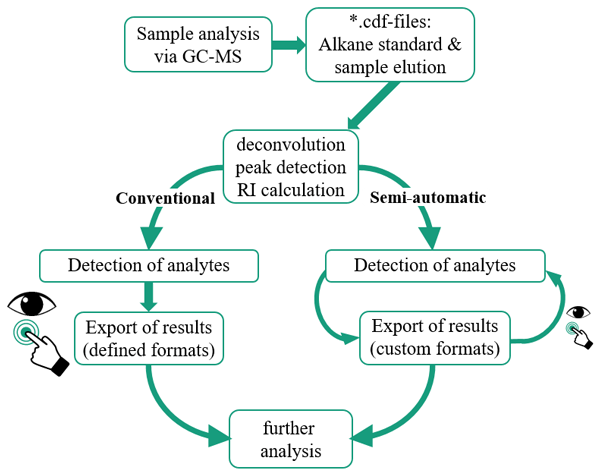
In this work, we have developed and validated a semi-automatic approach that greatly reduces the amount of interaction and effort needed for analyzing samples via gas chromatography–mass spectrometry. Further, unlike many other approaches, our developed tool is accessible to the novice and does not require any programming experience. Using whisky as an example substance, we show how the analysis method compares to conventional software, and we validate our approach against that.
Cited articles
Baur, T., Schütze, A., and Sauerwald, T.: Optimierung des temperaturzyklischen Betriebs von Halbleitergassensoren, Tech. Mess., 82, 187–195, https://doi.org/10.1515/teme-2014-0007, 2015.
Baur, T., Schultealbert, C., Schütze, A., and Sauerwald, T.: Novel method for the detection of short trace gas pulses with metal oxide semiconductor gas sensors, J. Sens. Sens. Syst., 7, 411–419, https://doi.org/10.5194/jsss-7-411-2018, 2018a.
Baur, T., Schultealbert, C., Schütze, A., and Sauerwald, T.: Device for the detection of short trace gas pulses, Tech. Mess., 85, 496–503, https://doi.org/10.1515/teme-2017-0137, 2018b.
Belitz, H.-D., Grosch, W., and Schieberle, P.: Lehrbuch der Lebensmittelchemie, 6., vollst. überarb. Aufl., Nachdruck, Springer-Lehrbuch, Springer, Berlin, 1118 pp., ISBN 978-3-540-73201-3, 2012.
Costello, B. P. J. d. L., Ewen, R. J., Gunson, H., Ratcliffe, N. M., Sivanand, P. S., and Spencer-Phillips, P. T. N.: A prototype sensor system for the early detection of microbially linked spoilage in stored wheat grain, Meas. Sci. Technol., 14, 397–409, https://doi.org/10.1088/0957-0233/14/4/301, 2003.
Costello, B. P. J. d. L., Ewen, R. J., Gunson, H. E., Ratcliffe, N. M., and Spencer-Phillips, P. T. N.: The development of a sensor system for the early detection of soft rot in stored potato tubers, Meas. Sci. Technol., 11, 1685–1691, https://doi.org/10.1088/0957-0233/11/12/305, 2000.
Czerny, M., Christlbauer, M., Christlbauer, M., Fischer, A., Granvogl, M., Hammer, M., Hartl, C., Hernandez, N. M., and Schieberle, P.: Re-investigation on odour thresholds of key food aroma compounds and development of an aroma language based on odour qualities of defined aqueous odorant solutions, Eur. Food Res. Technol., 228, 265–273, https://doi.org/10.1007/s00217-008-0931-x, 2008.
Fuchs, C., Lensch, H., Brieger, O., Schütze, A., and Baur, T.: P9.6 – Versatile platform for metal oxide semiconductor gas sensors for application specific optimization of temperature cycled operation, 15th Dresdener Sensor-Symposium, Poster, online, 6–8 December, 2021, 316–320, https://doi.org/10.5162/15dss2021/P9.6, 2021.
Hofmann, T., Schieberle, P., Krummel, C., Freiling, A., Bock, J., Heinert, L., and Kohl, D.: High resolution gas chromatography/selective odorant measurement by multisensor array (HRGC/SOMSA): a useful approach to standardise multisensor arrays for use in the detection of key food odorants, Sensor. Actuat. B-Chem., 41, 81–87, https://doi.org/10.1016/S0925-4005(97)80280-8, 1997.
Joppich, J., Su, Z., Marschibois, M., Karst, K., Bur, C., and Schütze, A.: 2.3 – MOS Sensors for Spoilage Detection of Milk using GC-MS and Human Perception as Reference, 16. Dresdener Sensor-Symposium, Dresden, Germany, 5–7 December 2022, Vorträge, 17–22, https://doi.org/10.5162/16dss2022/2.3, 2022.
Keller, A., Zhuang, H., Chi, Q., Vosshall, L. B., and Matsunami, H.: Genetic variation in a human odorant receptor alters odour perception, Nature, 449, 468–472, https://doi.org/10.1038/nature06162, 2007.
Koehne, M., Penagos Carrascal, O. T., Sauerwald, T., and Zeh, G. (Eds.): C2.3 – Entwicklungsplattform für Geruchsmesssysteme, 22. GMA/ITG-Fachtagung Sensoren und Messsysteme, Nürnberg, Germany, 11–12 June 2024, Vorträge, 230–235, https://doi.org/10.5162/sensoren2024/C2.3, 2024.
Kohl, D., Heinert, L., Bock, J., Hofmann, T., and Schieberle, P.: Systematic studies on responses of metal-oxide sensor surfaces to straight chain alkanes, alcohols, aldehydes, ketones, acids and esters using the SOMMSA approach, Sensor. Actuat. B-Chem., 70, 43–50, https://doi.org/10.1016/S0925-4005(00)00552-9, 2000.
Laor, Y., Parker, D., and Pagé, T.: Measurement, prediction, and monitoring of odors in the environment: a critical review, Rev. Chem. Eng., 30, 139–166, https://doi.org/10.1515/revce-2013-0026, 2014.
Mahmoud, M. A. A. and Zhang, Y.: Enhancing Odor Analysis with Gas Chromatography-Olfactometry (GC-O): Recent Breakthroughs and Challenges, J. Agr. Food Chem., 72, 9523–9554, https://doi.org/10.1021/acs.jafc.3c08129, 2024.
Motalebi Damuchali, A. and Guo, H.: Evaluation of a field olfactometer in odour concentration measurement, Biosyst. Eng., 187, 239–246, https://doi.org/10.1016/j.biosystemseng.2019.09.007, 2019.
Oleszkiewicz, A., Heyne, L., Sienkiewicz-Oleszkiewicz, B., Cuevas, M., Haehner, A., and Hummel, T.: Odours count: human olfactory ecology appears to be helpful in the improvement of the sense of smell, Sci. Rep., 11, 16888, https://doi.org/10.1038/s41598-021-96334-3, 2021.
Ortner, E., Granvogl, M., and Schieberle, P.: Elucidation of Thermally Induced Changes in Key Odorants of White Mustard Seeds (Sinapis alba L.) and Rapeseeds (Brassica napus L.) Using Molecular Sensory Science, Agr. Food Chem., 64, 8179–8190, https://doi.org/10.1021/acs.jafc.6b03625, 2016.
Penagos Carrascal, O., Zeh, G., and Sauerwald, T. (Eds.): A4.3 – PC-MOS-Sensorsysteme zur Detektion von flüchtigen organischen Verbindungen in Luft, 22. GMA/ITG-Fachtagung Sensoren und Messsysteme, Nürnberg, Germany, 11–12 June 2024, Vorträge, 101–107, https://doi.org/10.5162/sensoren2024/A4.3, 2024.
Poghossian, A., Geissler, H., and Schöning, M. J.: Rapid methods and sensors for milk quality monitoring and spoilage detection, Biosens. Bioelectron., 140, 111272, https://doi.org/10.1016/j.bios.2019.04.040, 2019.
Prado, K. S., Strangl, M., Pereira, S. R., Tiboni, A. R., Ortner, E., Spinacé, M. A. S., and Buettner, A.: Odor characterization of post-consumer and recycled automotive polypropylene by different sensory evaluation methods and instrumental analysis, Waste Manage., 115, 36–46, https://doi.org/10.1016/j.wasman.2020.07.021, 2020.
Proserpio, C., Graaf, C. de, Laureati, M., Pagliarini, E., and Boesveldt, S.: Impact of ambient odors on food intake, saliva production and appetite ratings, Physiol. Behav., 174, 35–41, https://doi.org/10.1016/j.physbeh.2017.02.042,2017.
Reimringer, W., Haug, H., Seifert, L., and Sauerwald, T.: Sampling Apparatus for the Process Monitoring of Contaminants in Polyolefin Recycling, 2024 IEEE International Instrumentation and Measurement Technology Conference (I2MTC), Glasgow, United Kingdom, 20–23 May 2024, 6 pp., https://doi.org/10.1109/I2MTC60896.2024.10560580, 2024.
Rusinek, R., Siger, A., Gawrysiak-Witulska, M., Rokosik, E., Malaga-Toboła, U., and Gancarz, M.: Application of an electronic nose for determination of pre-pressing treatment of rapeseed based on the analysis of volatile compounds contained in pressed oil, Int. J. Food Sci. Tech., 55, 2161–2170, https://doi.org/10.1111/ijfs.14392, 2020.
Schultealbert, C., Baur, T., Schütze, A., Böttcher, S., and Sauerwald, T.: A novel approach towards calibrated measurement of trace gases using metal oxide semiconductor sensors, Sensor. Actuat. B-Chem., 239, 390–396, https://doi.org/10.1016/j.snb.2016.08.002, 2017.
Schultealbert, C., Amann, J., Baur, T., and Schütze, A.: Measuring Hydrogen in Indoor Air with a Selective Metal Oxide Semiconductor Sensor, Atmosphere, 12, 366, https://doi.org/10.3390/atmos12030366, 2021.
Sensirion: SGP40 – VOC sensor for HVAC and air quality applications: Datasheet SGP40, https://sensirion.com/products/catalog/SGP40, last access: 30 August 2023.
Song, H. and Liu, J.: GC-O-MS technique and its applications in food flavor analysis, Food Res. Int., 114, 187–198, https://doi.org/10.1016/j.foodres.2018.07.037, 2018.
VDI/VDE 3518 Part 3: Multigassensoren – Geruchsbezogene Messungen mit elektronischen Nasen und deren Prüfung, https://www.vdi.de/richtlinien/details/vdivde-3518-blatt-3-multigassensoren-geruchsbezogene-messungen-mit-elektronischen-nasen-und-deren-pruefung (last access: 20 October 2023), 2018.
Wang, Y., Shao, L., Kang, X., Zhang, H., Lü, F., and He, P.: A critical review on odor measurement and prediction, J. Environ. Manage., 336, 117651, https://doi.org/10.1016/j.jenvman.2023.117651, 2023.
Zeh, G., Koehne, M., Grasskamp, A., Haug, H., Singh, S., and Sauerwald, T. (Eds.): Towards Artificial Intelligent Olfactory Systems, 2022 IEEE International Symposium on Olfaction and Electronic Nose (ISOEN), Aveiro, Portugal, 29 May–1 June 2022, 2 pp., https://doi.org/10.1109/ISOEN54820.2022.9789600, 2022.
Short summary
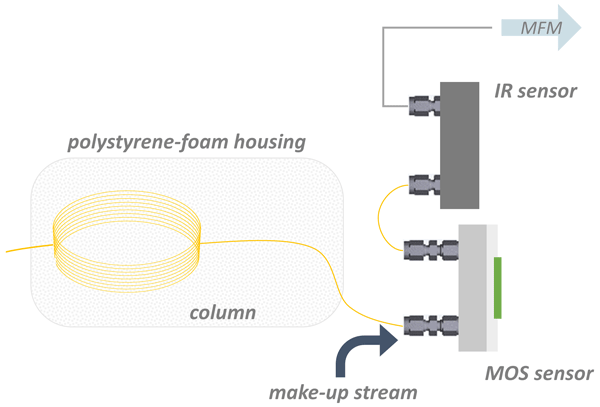
Continuous odor monitoring is becoming increasingly important. Therefore, odor monitoring systems are needed that are less expensive than conventional laboratory equipment and do not require trained personnel. Here, a gas chromatography selective odorant measurement sensor array (GC-SOMSA) system is used as part of the development concept. It correlates a sensor response to a mass spectrometer signal and an odor impression. This allows for a fast and inexpensive characterization suitable for many applications.
Continuous odor monitoring is becoming increasingly important. Therefore, odor monitoring...
Special issue